Climate Change and Concrete Spalling: The Accelerating Threat to Coastal Australia
Concrete is the backbone of Australia’s coastal infrastructure — from apartment blocks and sea walls to bridges and marinas. Yet, in harsh marine environments, even the strongest concrete faces constant attack from salt, moisture, and temperature changes. With climate change, these challenges are no longer slow-moving issues. Rising sea levels, heavier storms, and more extreme weather are accelerating deterioration.
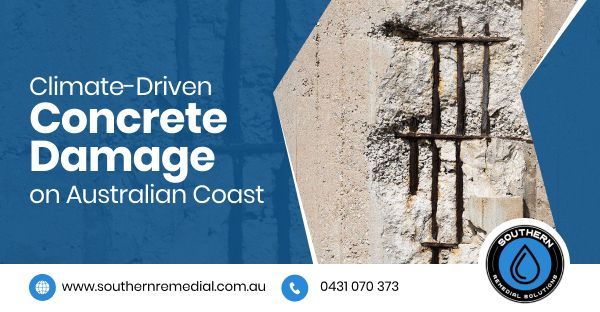
Concrete spalling, once a gradual process, is now appearing sooner and spreading faster. For property owners along Australia’s coast, this is more than a cosmetic concern. Spalling weakens structures, reduces safety, and drives up repair costs. Understanding what’s happening — and acting early — is now essential.
The Traditional Threats to Coastal Concrete Spalling
Concrete in marine areas has always faced tough conditions. Salt-laden air, wind, and moisture work together to corrode steel reinforcement and break down protective layers.
- Salt spray and chloride penetration
When salt spray lands on exposed concrete, chloride ions penetrate through pores and cracks. Over time, they reach the steel reinforcement, triggering corrosion. As the steel rusts, it expands, causing the surrounding concrete to crack and spall.
- Moisture exposure
Constant moisture prevents concrete from drying out. Damp conditions allow chlorides and carbon dioxide to migrate deeper into the structure, furthering corrosion and structural damage.
- Normal carbonation process
Carbonation is a slow chemical reaction between carbon dioxide and calcium hydroxide in concrete. This process reduces the concrete’s alkalinity, stripping away the natural protection around steel.
- Australia’s already harsh coastal conditions
Australia’s coastlines are exposed to high humidity, strong winds, and intense UV radiation. These factors combine to create a uniquely harsh environment where concrete degradation happens faster than in inland regions.
Understand if your house is ready for the next storm.
How Climate Change is Accelerating Deterioration
Concrete durability depends on environmental stability — something climate change is eroding.
- Rising Sea Levels
Sea levels around Australia are steadily rising, increasing the frequency of saltwater contact with foundations, retaining walls, and basements.
- Increased saltwater exposure
Structures once safely above tidal reach are now regularly exposed to salt spray or even partial submersion. The longer contact time allows more chloride ions to infiltrate concrete.
- Inundation of previously dry areas
Low-lying zones that were once dry are now being flooded during king tides or storm surges. Each event drives moisture deeper into the structure.
- Increased hydrostatic pressure
More frequent flooding places require greater hydrostatic pressure on basement walls and retaining structures, forcing water through cracks and joints.
- More Intense Storm Events
Stronger storms bring heavier rainfall and stronger winds, both of which threaten concrete structures.
- Stronger waves
Powerful waves drive saltwater deeper into the pores of coastal concrete, accelerating the corrosion process.
- Wind-driven rain
Wind carries moisture and salt further inland, affecting buildings that were previously considered low-risk. Protective coatings can wear away faster under these conditions.
- Erosion exposing structures
Coastal erosion removes soil and protective barriers, exposing foundations and piles that were never designed for direct exposure.
- Temperature Extremes
Greater temperature swings stress concrete through cycles of expansion and contraction.
- Thermal expansion and contraction
Frequent heating and cooling causes micro-cracks that allow more moisture and salt to penetrate.
- Faster chemical reactions
Higher temperatures speed up the chemical reactions responsible for corrosion and carbonation.
- Freeze-thaw cycles
While rare, southern Australia experiences occasional freeze-thaw cycles that cause water within concrete to expand and crack its surface.
- Increased Humidity
High humidity extends the time that concrete stays damp, especially in shaded or enclosed spaces.
- Longer moisture retention
Constant dampness allows chloride and carbon dioxide to move freely within concrete.
- Accelerated corrosion
Prolonged wetness keeps the embedded steel in a corrosion-prone state.
- Biological growth
Algae and lichens thrive on persistently damp concrete, trapping moisture and worsening surface deterioration.
Explore ways to save your house from rain damage.
Why Concrete Remediation is Utmost in Today’s Time
Corrosion and spalling are chemical processes — and like most reactions, they quicken under heat and moisture.
- Chloride ingress rates
As temperature and humidity rise, chloride ions move faster through concrete pores. What once took decades can now occur in half the time.
- Corrosion in warmer, wetter environments
Steel reinforcement corrodes more readily when both oxygen and moisture are abundant. Coastal areas with higher rainfall and sea spray see an exponential increase in corrosion rates.
- Permeability changes
Repeated heating and cooling expand the microstructure of concrete, making it more porous. More pores mean easier access for water and salts — a cycle that speeds up deterioration.
Visible Signs of Accelerated Deterioration
The effects of climate-driven deterioration are becoming easier to spot.
- Spalling and cracking
- Rust stains
- Surface scaling
- Structural weakness
Prevention and Concrete Remediation
Prevention remains the most cost-effective solution. However, once damage appears, professional concrete remediation is essential.
- Protective coatings and sealants
Applying marine-grade coatings or hydrophobic sealers can limit water and chloride ingress.
- Cathodic protection systems
These systems use electrical currents to prevent corrosion, ideal for large or high-value structures.
- Regular inspections
Scheduled assessments help detect early signs of spalling and deterioration before they spread.
- Early intervention strategies
Targeted patch repairs, re-alkalisation treatments, or re-coating can halt damage progression.
- Professional remedial services
Engaging specialists ensures accurate diagnosis and long-term repair. Teams experienced in coastal
concrete remediation
can identify hidden corrosion and apply solutions suited to local conditions.
Climate change is no longer a distant environmental concern — it’s a concrete reality for Australia’s coastal structures. Rising seas, frequent storms, and prolonged humidity are accelerating concrete spalling across the nation’s shoreline.
Proactive maintenance and professional concrete remediation can protect valuable assets from escalating damage and costly failures. Regular inspections, quality materials, and expert repair services are now essential defences against a changing climate.
For coastal property owners, the message is clear: act early, maintain regularly, and seek expert advice before minor damage becomes a major problem. For major issues, get in touch with us at 0431 070 373 or visit our website at https://www.southernremedial.com.au/ for more information.